In California, “modular,” “manufactured,” and “stick-built” are three legally distinct categories of permanent housing — and confusing them costs buyers tens of thousands of dollars, or a lender’s no.
Most national comparison articles get the broad strokes right but miss what matters most to California buyers: HCD vs. HUD, Title 24, Chapter 7A, and the real financing gap between modular and manufactured. This guide is the California version, written by a business that has delivered modular homes across California.
Quick Answer: The 30-Second Version
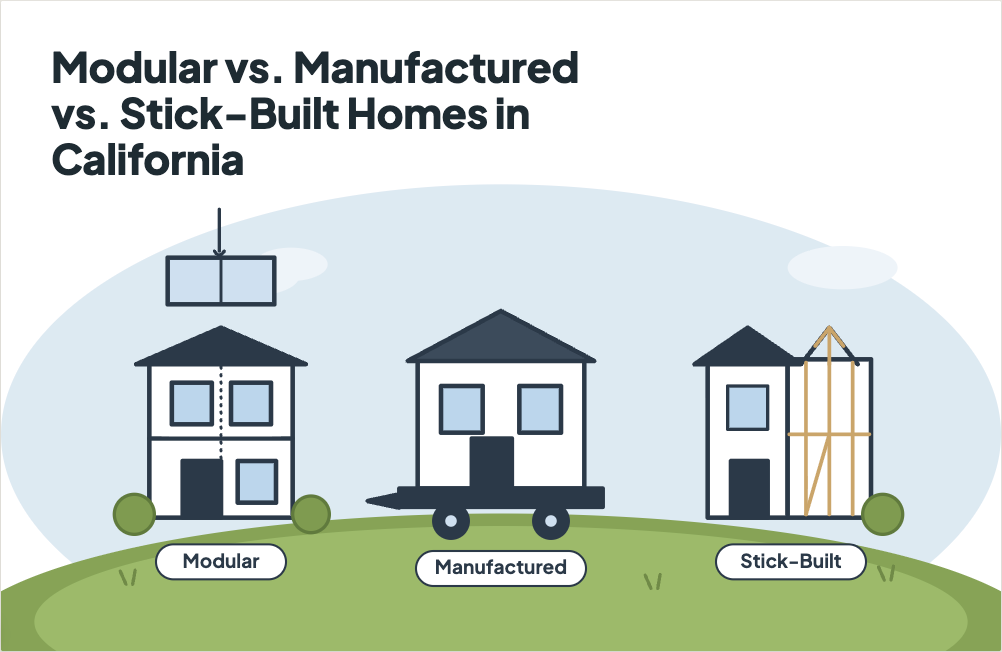
- Modular home — Built in a state-licensed factory to the California Building Code, regulated by HCD, installed on a permanent foundation, financed and titled as real property. The legal term for a Modular home in California is “Factory Built Housing,” but for simplicity we will use modular home in this article.
- Manufactured home — Built in a factory to the federal HUD Code on a permanent steel chassis. Financing and titling depend on whether it ends up on a permanent foundation.
- Stick-built home — Built entirely on-site to the California Building Code under direct county plan check. The most familiar path and the most customizable.
All three can be permanent California homes. The category determines the rules they’re built to, who inspects them, how they’re financed, and how they hold value.
What Is a Modular Home in California?
A modular home is constructed in sections inside a state-licensed factory, then transported to your site and assembled on a permanent foundation. In California, modular homes must be built to the California Building Code (CBC) — the same code a stick-built home is held to — including Title 24 for energy and Chapter 7A in Wildland-Urban Interface (WUI) zones.
HCD (the California Department of Housing and Community Development) certifies the factory, reviews the plans, and inspects modules in-plant. A state insignia on each module is proof of compliance. Your county building department handles the foundation, utilities, set inspection, and certificate of occupancy.
Once finished, a modular home is functionally indistinguishable from a comparable stick-built house. It sits on a permanent foundation, is titled as real property, and is financed with a standard conventional mortgage.
What Is a Manufactured Home?
A manufactured home is built in a factory to the federal HUD Code (24 CFR Part 3280), on a permanent steel chassis. The HUD Code sets nationwide standards for construction, fire safety, energy, and durability — a different code than the California Building Code, with different design priorities.
In California, manufactured homes are regulated by HCD’s manufactured-mobile-home division (separate from the factory-built / modular program). They can be installed on rented land in a manufactured-home community, on owned land with a pier-and-beam install, or on a permanent foundation. That installation choice has large downstream consequences for financing and resale.
A common point of confusion: a manufactured home on a permanent foundation with FHA Title II or Freddie Mac CHOICEHome financing looks superficially like a modular home — but it’s still HUD-coded, not built to the California Building Code, and treated differently by appraisers.
Note: “mobile home” is a legacy term for factory-built homes produced before June 15, 1976, when the HUD Code took effect. Modern manufactured homes are not mobile homes.
What Is a Stick-Built Home?
A stick-built home is constructed entirely on-site, framed piece by piece — the “sticks” — by carpenters and trades over weeks or months. It’s built to the California Building Code under direct county plan check.
Stick-built is the most familiar option in California, the most customizable, and the most architecturally flexible. Every detail — roof pitch, window placement, cabinet layout — can be specified from scratch. The trade-offs are timeline and weather exposure: framing happens outdoors, trade scheduling is sequential, and rain can move the schedule.
For buyers who want a fully custom home, aren’t in a hurry, and have the budget for a longer build, stick-built remains the right answer. It’s also the only practical option on certain lots where transport and crane access for modular isn’t feasible.
Side-by-Side Comparison
| Feature | Modular | Manufactured | Stick-Built |
| Code | California Building Code | Federal HUD Code | California Building Code |
| Regulator | HCD (state) | HUD / HCD MH division | County building dept. |
| Built where | State-licensed factory | Manufacturing factory | On-site |
| Foundation | Permanent | Pier-and-beam, foundation, or rented site | Permanent |
| Transport | Modules trucked, craned on | Towed on steel chassis | None — built on-site |
| Customization | High (pre-designed + custom) | Limited to mfr. options | Highest |
| Title 24 (CA energy) | Full compliance | Federal energy standards | Full compliance |
| Chapter 7A (WUI) | Required where applicable | Federal HUD standards | Required where applicable |
| Title | Real property | Real or personal (depends on install) | Real property |
| Financing | Conventional / construction-to-perm | Title II (real) or Title I (chattel) | Conventional / construction-to-perm |
| Build time | Months — factory + site in parallel | Shortest factory; site/setup separate | Typically longest |
| Resale comps | Site-built comparables | Other manufactured comparables | Site-built comparables |
California-Specific Differences That Most Articles Miss
Most national comparison articles miss the parts that matter most to California buyers. The big four:
1. HCD plan check vs. county plan check. Modular plans go through state HCD plan check once, then a streamlined county review for site work. Stick-built plans go through a full county plan check. In counties where building departments are slow, this matters.
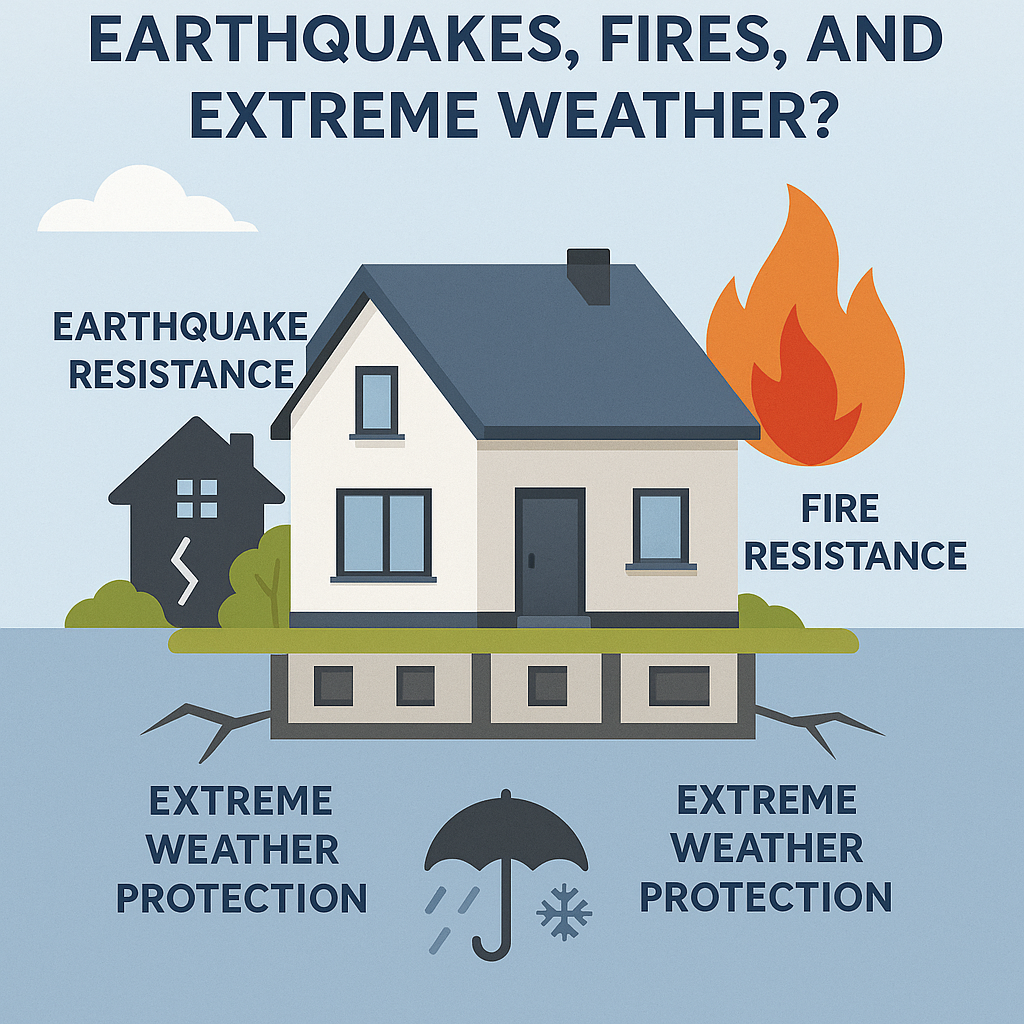
2. Title 24 energy compliance. Modular and stick-built homes are both built to the current Title 24 cycle (2025)for the structure, building envelope, HVAC, and (for most new homes) solar PV. Manufactured homes are built to the less stringent federal HUD energy standards, not Title 24.
3. Chapter 7A in WUI zones. California’s wildfire-resistant requirements apply to modular and stick-built homes in WUI zones — Class A roofs, ember-resistant vents, ignition-resistant siding, tempered windows. Manufactured homes follow federal HUD standards, which differ.
4. Prop 13 base-year value. New construction triggers a new assessment on the structure; the land typically retains its prior base-year value. Manufactured homes on permanent foundations are usually treated like other improvements. You will want to confirm any tax details with your County Assessor.
Financing: Where the Three Diverge Most
For most California buyers, this is where the categories matter most.
Modular and stick-built homes are both “real property” on permanent foundations. They qualify for the same conventional mortgages, the same construction-to-permanent loans, and the same Fannie Mae and Freddie Mac products. The financing is essentially identical.
Manufactured homes are where the path forks:
- Title II (real property) — A manufactured home on owned land and on a permanent foundation can be financed with an FHA Title II loan or with conventional programs like Freddie Mac CHOICEHome or Fannie Mae MH Advantage. Rates and terms look much like a conventional mortgage, but eligibility is stricter and not every manufactured home qualifies.
- Title I / chattel (personal property) — A manufactured home titled as personal property is financed with a chattel loan — typically higher rates, shorter terms, and lower LTV than a conventional mortgage.
The takeaway: modular and stick-built financing looks like any other home purchase. Manufactured financing depends heavily on the installation type and the program your lender works with — and the cost of capital can be materially different. Some federal regulations have become more flexible and supportive of Manufactured Homes in the last few years. To learn more you will want to look up the publications of HUD.
Resale Value: Do They Appreciate?
Modular and stick-built homes appreciate similarly in California because appraisers value them against the same comparables — both are real property, built to the same code, and indistinguishable to most buyers once finished. Long-term value follows location, condition, square footage, and the broader market.
Manufactured homes are more situation-dependent. On a permanent foundation with Title II financing, they tend to follow real-property appreciation in the local market. On non-permanent installs or in manufactured-home communities, value patterns can look closer to a vehicle than a traditional home depending on the location, manufacturer, specifications and maintenance.
If long-term resale is a top criterion, modular and stick-built are usually the safer bets. Confirm with current local comps before relying on any general claim.
Build Time: Realistic California Timelines
All three timelines are dominated by the same two variables — permits and site work — not by the construction method. That matters because modular marketing sometimes implies a 12-week build that ignores everything before set day.
- Modular — Contract-to-move-in typically 10-15 months. Factory build runs in parallel with site prep and foundation, which is where time is saved.
- Manufactured — Shortest factory time of the three. Total move-in depends on lot prep, foundation type, and whether the home goes on owned land or in a community.
- Stick-built — Contract-to-move-in typically 18-24 months. Linear, weather-dependent on-site build is the longest path.
Modular is faster than stick-built by months — not weeks.
Which One Is Right for You?
Three short paths, mapped to common situations:
- You want a real-property home, conventional mortgage, California code compliance, faster than stick-built — and you’re not chasing a fully custom architectural design. → Modular is usually the best fit.
- You’re prioritizing the lowest sticker price, you’re comfortable with the financing trade-offs (or planning a permanent foundation with Title II), and the smaller customization scope works for you. → Manufactured is worth a serious look.
- You want a fully custom, architecturally specific home, and you have the time and budget for a longer, on-site build. → Stick-built is the right call.
A short example: a first-time buyer in Santa Cruz with a 6,000 sq ft lot, a conventional pre-approval, and a 12-month timeline target — modular usually wins, because the schedule is more predictable, the financing is straightforward, and the resale comps line up with stick-built home.
A Note on Cutting Edge Homes
Cutting Edge Homes is a California modular builder with 2+ decades of California delivery experience and a catalog of 40+ pre-designed floor plans. We build to the California Building Code with 3rd Party State of California plan check and in-plant inspection. We’re not the right fit for every buyer, and we’ll say so when we’re not.
For the long version of how a California modular home gets built, financed, permitted, and delivered, read our California Modular Homes: The Complete 2026 Buyer’s Guide.
*A note on this article. Financing programs, Title 24 cycles, and California county rules change. Confirm specifics with a licensed lender and your county building department before relying on any rule, rate, or timeline cited above.
Conclusion
The California choice between modular, manufactured, and stick-built comes down to four things: which code the home is built to, how you plan to finance it, how customizable you need the design to be, and how long you’re willing to wait. Modular tends to win on schedule and California code parity. Manufactured wins on sticker price (with financing caveats). Stick-built wins on customization.
If modular looks like the right fit, read the California Modular Homes Buyer’s Guide for the full process. If not, the comparison above gives you a defensible position for the next conversation.