California homeowners now have three legal ways to add a second unit on a single-family lot — and they are not interchangeable. A JADU, an attached ADU, and a detached ADU each have different size limits, occupancy rules, and cost profiles. Pick the wrong one and you can stall a permit or spend tens of thousands more than you needed to.
This guide gives you plain-English definitions of all three, what each costs and earns, and a three-question decision tree that lands you on the right answer for your property.
The Three Types in One Sentence Each
- JADU (Junior ADU)— a small second unit (up to 500 sq ft) built inside your existing home, with a separate entrance and efficiency kitchen.
- Attached ADU— a self-contained second unit attached to your home (addition or connected garage conversion).
- Detached ADU— a fully separate, stand-alone second unit on the same lot.
All three are legal on most California single-family lots under state law. Which one is right depends on your land, budget, and goal.
What Is a JADU? (Junior Accessory Dwelling Unit)
A Junior ADU (governed by California Government Code § 65852.22) is built within the walls of your existing home — most often by converting a bedroom, home office, or attached garage. It can also be an addition. It’s capped at 500 square feet, must have a separate exterior entrance, and can include an efficiency kitchen (sink, small counter, and a 120-volt appliance). A JADU can have its own bathroom or share one with the primary home.
The big asterisk: owner-occupancy is required. The owner must live in either the primary home or the JADU, and that requirement is recorded as a deed restriction that travels with the title.
JADUs are the cheapest, smallest, and fastest type of ADU to build because most of the structure already exists. They work best for housing a family member or generating modest rental income from existing square footage.
What Is an Attached ADU?
An attached ADU is a full second unit physically connected to your primary home — typically a side or rear addition, or a garage conversion that shares a wall with the main house. It’s governed by California Government Code § 65852.2 alongside detached ADUs.
Attached ADUs are larger than JADUs (state law allows substantial sizes; local rules cap how much), must have their own kitchen and bathroom, and need a separate entrance. Owner-occupancy is not required under current state law, so you can build one and rent both units out. Parking exemptions apply in many cases, particularly near transit.
Attached ADUs fit best when you have unused side-yard or garage square footage and want a real second unit without owner-occupancy strings.
What Is a Detached ADU?
A detached ADU is a stand-alone second unit on the same lot — a small house in the backyard, side yard, or a vacant portion of the lot. State law sets a baseline of 800 square feet, and many cities allow up to 1,200 square feet or more. Owner-occupancy is not required.
Detached ADUs typically command the highest rent because tenants get full privacy, and they tend to add the most resale value. The trade-off is cost and timeline — you’re effectively building a small house, including foundation and utilities. Modular construction can compress that timeline significantly (more below).
Side-by-Side Comparison
| Feature |
JADU |
Attached ADU |
Detached ADU |
| Statute |
Gov. Code § 65852.22 |
Gov. Code § 65852.2 |
Gov. Code § 65852.2 |
| Max size |
500 sq ft |
Substantial; local cap |
Up to 1,200 sq ft (local) |
| Location |
Inside primary home |
Attached addition / garage |
Stand-alone on lot |
| Kitchen |
Efficiency kitchen |
Full kitchen required |
Full kitchen required |
| Bathroom |
Own or shared with primary |
Own bathroom required |
Own bathroom required |
| Owner-occupancy |
Required (deed restriction) |
Not required |
Not required |
| Parking |
Often exempt |
Often exempt (transit) |
Often exempt (transit) |
| Typical cost |
Varies |
Varies |
Varies |
| Typical rent |
Varies |
Varies |
Varies |
| Can be sold separately? |
No |
Yes, under AB 1033 (where adopted) |
Yes, under AB 1033 (where adopted) |
| Permit timeline |
Fastest |
Moderate |
Longest |
Can You Have Both? (ADU + JADU on One Lot)
In most cases, yes. State law allows a single-family lot to have one ADU plus one JADU at the same time. You could build a detached ADU in the backyard for rental income and convert an interior bedroom into a JADU for an aging parent — on the same property. Local rules vary on how the two interact (parking, setbacks, utilities), so confirm what is allowed with your city or county planning department.
Decision Tree: Which ADU Is Right for Your Property?
Three questions get most homeowners to a clear answer.
1. Do you (or will you) live in the primary home?
- No→ JADU is off the table (owner-occupancy required). Continue to Q2.
- Yes→ All three are on the table. Continue to Q2.
2. How much usable land do you have?
- Backyard or side yard for a stand-alone structure→ Detached ADUis feasible. Continue to Q3.
- Unused garage or side-yard footprint connected to the home→ Attached ADU.
- No buildable land outside the home footprint→ JADU (carved from interior square footage).
3. What are you optimizing for?
- Highest rental income / best resale→ Detached ADU.
- Family member with privacy at moderate cost→ Attached ADU.
- Smallest budget, fastest permit, or in-home office / guest suite→ JADU.
In practice: backyard + rental-income goal usually lands at detached; no backyard but unused interior space usually lands at JADU; attached lands in the middle when a garage or side addition is already on the table.
A Note on Modular Detached ADUs
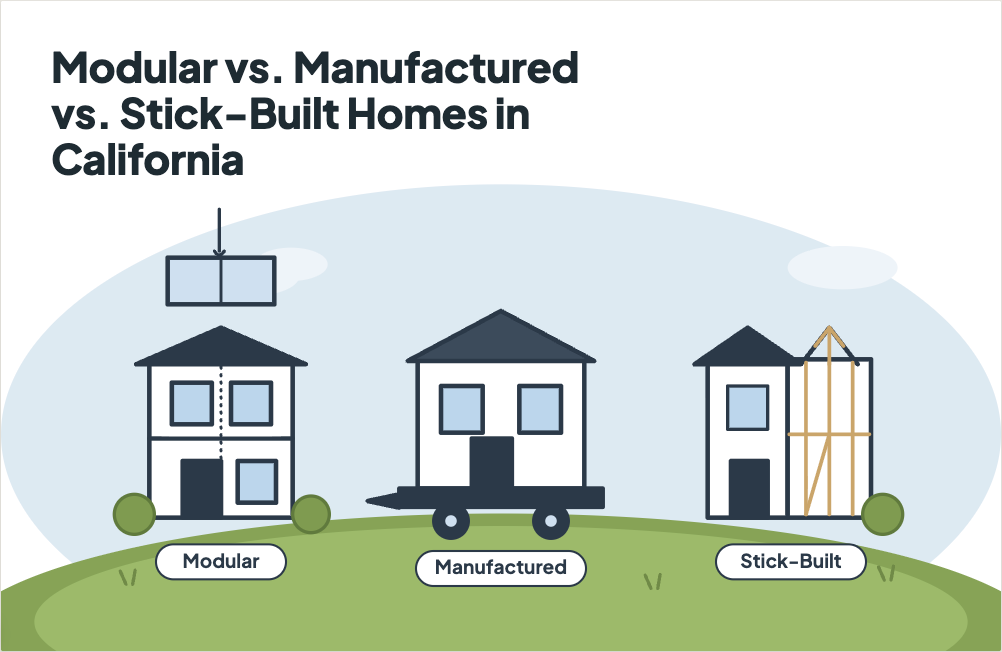
If you land on a detached ADU, modular construction is one of the fastest, most predictable paths. The unit is built in a state-licensed factory to the California Building Code, then transported and set on a permanent foundation. Factory work runs in parallel with site prep, so the on-site timeline is dramatically shorter than a fully site-built ADU — and the bulk of the build happens in a controlled environment, which gives you cost certainty earlier. Our catalog includes detached ADU plans designed for California rules, including the Adudio 552.
What to Do Next
Three short paths based on where the decision tree landed you:
- Leaning JADU→ Have a contractor or designer review your floor plan and identify the smallest, simplest space to convert. Savings come from minimizing structural changes.
- Leaning attached ADU→ Confirm setbacks, parking, and the utility tie-in plan with your city or county before designing.
- Leaning detached ADU→ Book a feasibility check on your lot — zoning, setbacks, soil, utilities, and access — before committing to a size. This is where pre-engineered modular catalog plans become useful.
****Local rules vary.*This article describes California state law as it stood at publication. Cities and counties layer their own ADU ordinances on top, and ADU legislation continues to evolve — including potential updates in 2026 that may not yet be reflected on HCD’s site. Confirm specifics with your city or county planning department or with our team before relying on them.