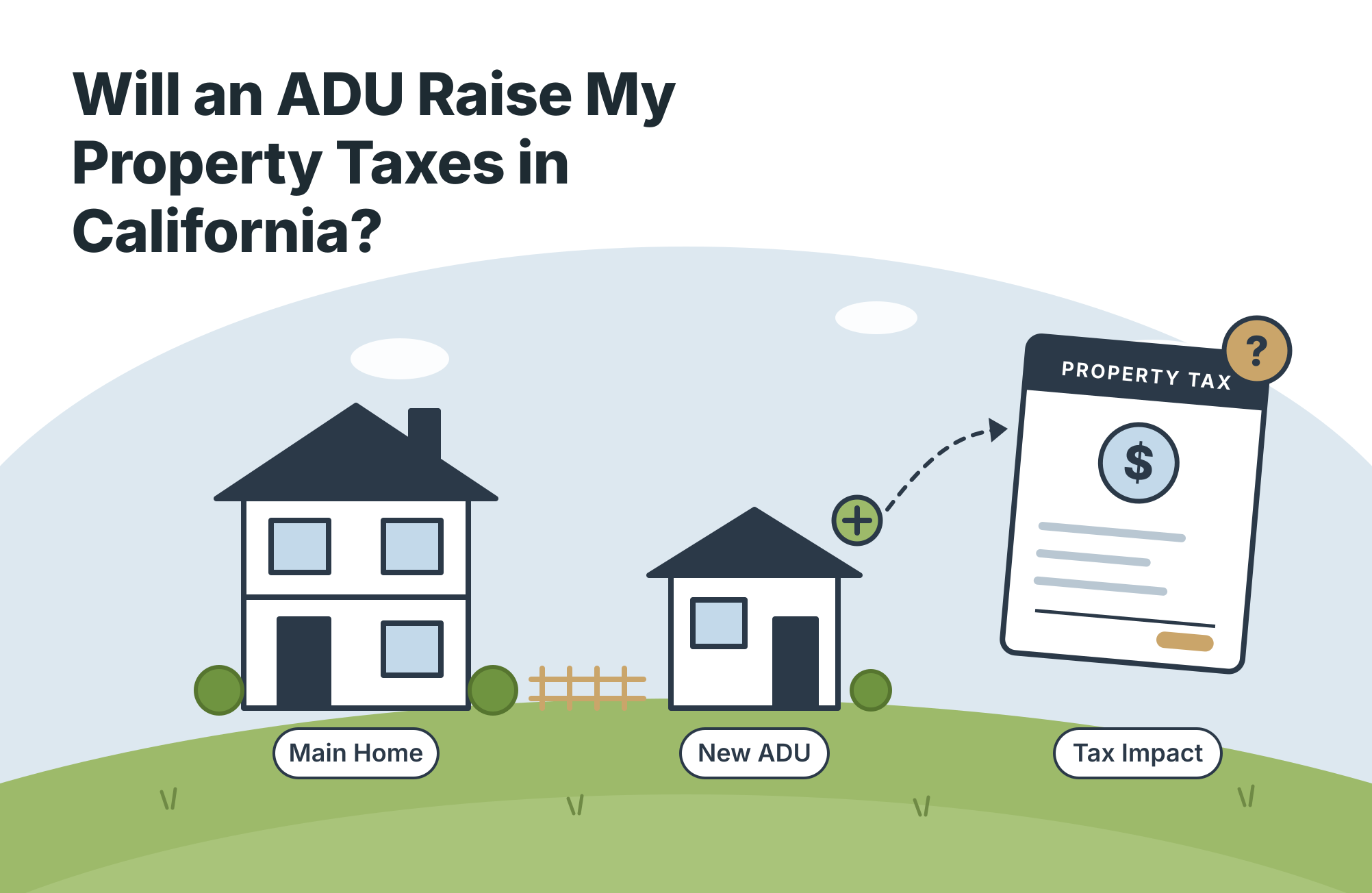
Generally, yes, adding an ADU in California can increase your property taxes, but it generally doesn't trigger a full reassessment of your existing home and land under Prop 13. The county assessor values the assessable new construction on your property and adds it to your assessment. This article walks through the mechanism and a hypothetical example.
Many California landowners hesitate to build an ADU because they've heard the assessor might reassess the entire property at current market value, wiping out years of Prop 13 protection. That isn't how new construction is generally taxed. The guide below walks through the actual mechanism and the next step to get a real number for your specific property.
How California Property Tax Works Under Prop 13
Proposition 13 (Article XIII A of the California Constitution) caps the base ad valorem property tax at 1% of a property's assessed value, and locks in that assessed value at purchase (or at a triggering event) with no more than a 2%/year adjustment, even when market value rises much faster. Under California Revenue and Taxation Code § 70, assessable new construction is added at its own assessed value; existing structures on the same property generally are not reassessed as a result.
In practice, most California homeowners pay slightly more than the 1% base rate once voter-approved bonds and local assessments are included. Areas with Mello-Roos or heavy bond debt can be materially higher. Your specific effective rate is printed on your annual property tax bill, use that figure rather than a general estimate when you're doing your own math. Note that some charges on the bill are fixed or special assessments and don't all scale with assessed value.
What Actually Happens When You Add an ADU
The county assessor performs a supplemental assessment (R&T Code § 75) on the assessable new construction:
- The ADU reaches completion of new construction, as determined by the assessor. (Construction that is still in progress on January 1 of a given year can also be subject to assessment at its then-current state of completion.)
- The county assessor determines an assessed value for the assessable new construction.
- Depending on the timing of completion within the fiscal year, the project may result in one or two supplemental tax bills — these are separate from the regular annual property tax bill.
- The assessable new construction's value then rolls into the regular annual property tax bill going forward.
The assessor sets the value; the county tax collector is the office that sends the bills. The existing home and land are generally not reassessed as part of this process, the new assessment attaches to the assessable new construction.
How the Assessor Values the ADU
The assessor determines the value of assessable new construction based on the information available to the office. The cost approach, estimating value based on typical replacement cost, is commonly used for new residential construction. Your contract price with the builder can inform the assessor's determination, but it is not automatically the assessed value. The assessor's determination can be higher or lower than contract price depending on the approach used, the specifics of the project, and county practice.
For a project-specific estimate of value and tax, the county assessor's office is the authoritative source. A licensed tax adviser or CPA can help interpret the result in the context of your finances.
A Hypothetical Example
The figures below are hypothetical — illustrative only, to show how the math works. Your numbers will differ. Contact your county assessor for a property-specific estimate.
The point of the example is the mechanism: the existing home's $500,000 assessed value is generally unchanged, and the ADU's assessed value is added on top. The hypothetical additional annual value-based tax (~$2,300 here) reflects the ADU alone. Fixed assessments and special charges on your bill don't all scale with value, so the actual change on your bill may differ from a simple rate-times-value calculation, another reason to go to the assessor for a property-specific number.
The Supplemental Tax Bill You May Receive
After completion of new construction, depending on timing within the fiscal year, the project may result in one or two supplemental tax bills. These are separate from the regular annual property tax bill, and they're a common feature of any new construction, not unique to ADUs. The regular annual bill going forward will include the assessable new construction's value.
The supplemental bill can surprise homeowners because it arrives outside the normal tax cycle. Factor it into your first-year budget.
Special Situations Worth Knowing
- Garage conversion. A garage conversion can also create assessable new construction. The effect on your assessment depends on the specific work performed and the assessor's determination.
- JADU (Junior ADU). A JADU can similarly create assessable new construction within the primary home. As with any ADU project, the specific effect on assessment depends on the work and the assessor.
- Attached vs. detached ADU. Both are new construction. The assessor's determination applies to the assessable new construction on the property; the existing home and land are generally not reassessed as a result.
How to Get a Real Number for Your Property
- Contact your county assessor's office. The assessor is the authoritative source for how assessable new construction will be valued on your specific property. Many California county assessors publish general resources online.
- Look at your most recent property tax bill to see your current assessed value and the breakdown of value-based tax, fixed assessments, and special charges that make up your total.
- Consult a licensed tax adviser or CPA for how the result fits into your finances or any ROI modeling on the ADU. This article is educational and is not tax advice.
How CEH Helps You Plan Around This
For California homeowners considering a factory-built ADU, we help you explore designs, delivery access to your site, and proposed scope. Site work, foundation, and approvals assigned in the project agreements are part of our pre-construction process. The tax impact itself is handled by the county assessor (for value and bills) and your tax adviser (for how it fits your finances) — that's the right path for a property-specific number.
Frequently Asked Questions
Will an ADU raise my property taxes in California?
Generally, yes, but it generally doesn't trigger a full reassessment of your existing home and land. The assessor values the assessable new construction and adds it to your assessment (R&T Code § 70).
Does adding an ADU trigger a full property reassessment under Prop 13?
Generally, no. Prop 13 generally protects existing structures from reassessment when assessable new construction is added. The assessable new construction is valued and added.
How is the ADU value calculated for property tax purposes?
The county assessor determines the value. A cost approach — based on typical replacement cost, is commonly used for new residential construction. Your contract price with the builder can inform the determination but is not automatically the assessed value.
Do I get a supplemental tax bill after building an ADU?
Depending on when completion of new construction occurs within the fiscal year, the project may result in one or two supplemental tax bills (R&T Code § 75). These are separate from your regular annual property tax bill.
Does converting my garage to an ADU raise my property tax the same way?
A garage conversion can also create assessable new construction. The effect on your assessment depends on the specific work performed and the assessor's determination, a general rule in either direction doesn't apply.
Conclusion
Adding an ADU in California generally increases property taxes, but it generally doesn't trigger a full reassessment of your existing home and land. The assessor values the assessable new construction and adds it to your assessment; the county tax collector sends the bills. For a property-specific number, the county assessor is the authoritative source, and a licensed tax adviser or CPA can help interpret it against your finances.
Considering a factory-built ADU? We can help you explore designs, delivery access to your site, and proposed scope, including a route survey where it's useful. Schedule an introductory call to walk through what a factory-built ADU could look like on your property. For tax estimates, your county assessor is the right next step, and for how it fits your finances, a licensed tax adviser. For the broader landowner playbook, read the complete ADU guide for California homeowners.